- The pamphlet on citizen scientists septembre 4th, 2010Continue reading…
This pamphlet is an output of the STACS (Science, Technology and Civil Society) project, funded by the European Commission Sixth Framework Programme (Science and Society-19-044597).
The pamphlet
Preface: Fieldwork
Consider the cauliflower. The cauliflowers we eat now tend to be big, white and fluffy. They have been bred this way over the last 30 years, taking the place of the various Italian varieties that were once bred on farms. Europe has largely forgotten the other possible shapes, colours – green, yellow, pink and purple – and flavours of cauliflowers. In the fields and village markets of Brittany, a group of farmers, activists and scientists are trying to help us remember.
- Lettre de soutien au professeur Gilles-Eric Séralini et ses collègues / Support Letter to Gilles-Eric Séralini and his colleagues mai 5th, 2010Continue reading…
- The French salt industry in court avril 27th, 2009Continue reading…
Abstract : In 2008, the French salt industry lost a high-profile libel case brought by its agent the Comité des Salines de France against Pierre Meneton, a medical research worker. In 2002, and in 2004, France’s Food Safety Agency and National Academy of Medicine recommended that the population’s salt intake be reduced in line with worldwide dietary guidelines that had been evolving for more than 50 years.2,3 The Comité subsequently seemed to focus much of its argument against this recommendation towards Pierre Meneton, of the National Institute of Health and Medical Research, who was trying to implement national recommendations for dietary salt intake.
- Save the world and keep a career décembre 8th, 2005If the prospect of endless lab work doesn’t appeal, maybe using your qualifications to address global problems more directly would be the answer. There is plenty of scope for those who wish to pursue science with a ‘social conscience’, as Virginia Gewin finds out.Continue reading…We aim at increasing the capacity for research and expertise of civil society, NGOs, consumerists, citizen movements and trade unions. We support the establishment of a “scientific third sector” that is better able to meet the growing social and ecological demands, which are neglected by the major scientific orientations whether they be defined by the state or by private industry.
- 2nd TeRRIFICA Reflective Workshop on Key Performance Indicators – « Science meets Parliaments », Belgrade juillet 9th, 2019Continue reading…

After a successful 1st TeRRIFICA Reflective Workshop, TeRRIFICA will hold the 2nd TeRRIFICA Reflective Workshop at the National Assembly of the Republic of Serbia on July 10th and 11th.
This workshop is part of the ‘Science Meets Parliaments’ event organized for the first time in Serbia by the Center for the Promotion of Science in collaboration with the Ministry of Education, Science and Technological Development, and under the patronage of the Joint Research Centrе(JRC) of the European Committee.
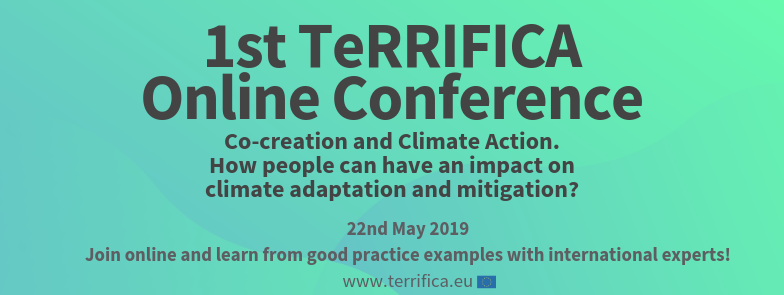
- 1st TeRRIFICA Online Conference: “Co-creation and Climate Action. How people can have an impact on climate adaptation and mitigation?” mai 14th, 2019Continue reading…
“Climate change is the defining challenge of our time. Mitigating its impacts and adapting to changes already taking place or impossible to avoid will require fundamental changes to societies and behaviours all over the world – as well as scientific breakthroughs, both technological and social” (Climate Change Adaptation – Directorate-General for Research and Innovation, European Commission). It is in this context the TeRRIFICA project emerges and organizes its 1st TeRRIFICA Online Conference. How can people have an impact on climate adaptation and mitigation? How can co-creation and participatory methodologies be implemented into climate action? These and other questions will be discussed during the event.
- Europe defies climate change: Kick-off meeting of the TeRRIFICA project février 18th, 2019
Continue reading…The first meeting of the European project TeRRIFICA was held in Bonn (Germany) on the 4th and 5th February 2019. Eight European institutions start to work together to foster competence for climate change adaptation in different European regions with a specific focus on Responsible Research and Innovation. The project embeds the United Nations 2030 Agenda for Sustainable Development and its Sustainable Development Goals, a landmark achievement that provides a shared global vision towards sustainable development.
- Scientists and Civil Society Must Move Together toward a New Science mai 18th, 2016
Continue reading…Article proposed and written by an advisory board member of Sciences Citoyennes, Christian Vélot1,2,3,4* , about democracy in science and public engagement, illustrated by a concrete example of participatory research. This is an open-access article, originally published here : http://journal.frontiersin.org/article/10.3389/fpubh.2016.00096/full.
- « Collective wisdom », an interview with Claudia Neubauer, FSC juin 22nd, 2012
Continue reading…Fondation Sciences Citoyennes wants science to be closer to the real concerns of citizens. In Paris, Tania Rabesandratana spoke with the organisation’s director Claudia Neubauer about her fight for unbiased, participatory research.
Science in Society was Framework 7’s funding programme dedicated to reflection and debate on science and technology in our society. It had a budget of €330 million for 2007-13, but the programme has been axed in the proposal for Horizon 2020, the follow-up to Framework 7 for 2014-20. Fondation Sciences Citoyennes, a French not-for-profit association, is among those who are fighting to reverse the programme’s removal. The organisation, founded in Paris in 2002 by a group of researchers, has urged the European Commission to create a comparable funding stream for Horizon 2020 with a €1-billion budget, or 1.25 per cent of the proposed €80bn total budget.
- 5th Living Knowledge Conference (LK5) in Bonn (2012) mai 10th, 2012
Continue reading…Re-imagining Research Relationships – Co-creating Knowledge in a Democratic Society
This conference will provide an opportunity for policy makers, academics and civil society organisations to consider current practice and future opportunities in the field of research partnerships.
The 5th Living Knowledge Conference will set its focus on different themes to get more insight in processes, and develop specific policy recommendations that resonate with public concerns and articulated research needs and built on the experience and know-how of the previous LK conferences in Leuven, Seville, Paris and Belfast. It will be an opportunity to bring together some of the key thinkers and practitioners in the area of community based research, university/community partnerships and Science Shops and aims at providing options and opportunities for collaborations and ensuring that this area of work is prioritised on policy agendas both nationally and internationally.
The conference will also be a platform to exchange and discuss findings and results of the first half of the PERARES project. PERARES (Public Engagement with Research and Research Engagement with Society) is a project which has been awarded financial support by the European Commission as coordination action in the 7th Framework Programme for broarder engagement on science-related questions and structuring public engagement in research.
- Project « Co-construction of knowledge and of decisions in research: the example of participatory plant breeding in agri-environment » février 29th, 2012
Continue reading…The project « Co-construction of knowledge and of decisions in research: the example of participatory plant breeding in agri-environment », was directed by the Fondation Sciences Citoyennes, in partnership with the Réseau Semences Paysannes (Peasant seeds network). The project was funded by REPERE program called Network of Exchange and Projects for Research and Expertise Governance. The French Ministry of Environment implemented it.
- The pamphlet on citizen scientists septembre 4th, 2010
Continue reading…This pamphlet is an output of the STACS (Science, Technology and Civil Society) project, funded by the European Commission Sixth Framework Programme (Science and Society-19-044597).
The pamphlet
Preface: Fieldwork
Consider the cauliflower. The cauliflowers we eat now tend to be big, white and fluffy. They have been bred this way over the last 30 years, taking the place of the various Italian varieties that were once bred on farms. Europe has largely forgotten the other possible shapes, colours – green, yellow, pink and purple – and flavours of cauliflowers. In the fields and village markets of Brittany, a group of farmers, activists and scientists are trying to help us remember.
- Towards a real partnership with society – NGO alliance on Framework programme 7 of the EC juin 4th, 2005
Continue reading…European Science Social Forum Network
The European Science Social Forum Network was a platform of non-profit associations and NGOs as well as individual persons that worked to get a model of scientific and technological progress engaged with a solidary, sustainable and fair society.
During the third European Social Forum held from the 15th to the 17th October 2004 in London, a number of NGOs and associations working on the field of science and society (i.e., commercial control of science, science and militarism, human genetics, agriculture, science and citisenship, etc) came together. The opportunity was used to stablish an informal network that would help us to coordinate campaigns and organize common actions, as well as to share information, documents, ideas, human resources, etc.
- Towards a citizens’ science in Europe : new forms of co-operation between NGOs, citizens and researchers novembre 13th, 2003
Continue reading…Scientific knowledge plays a determining role in the societal development provoking profound social, political, economic and cultural transformations. Traditionally scientific knowledge is seen as being neutral and independent but in fact it is contested and negotiated knowledge that is more and more influenced by pure economic factors and for which the economic and organisational resources are unequally distributed in the society.
- Europe defies climate change: Kick-off meeting of the TeRRIFICA project février 18th, 2019
- 2nd TeRRIFICA Reflective Workshop on Key Performance Indicators – « Science meets Parliaments », Belgrade juillet 9th, 2019

Our resources in English
Dear visitor, you will find on this page some of our articles in English. Unfortunately, we are unable to translate all of our documents in English, but we are doing our best to display the most relevant ones. If you want to help us developping this English part by translating some documents, please contact us at equipe@sciencescitoyennes.org.
An engine of emancipation for several centuries, science, now techno-science, is tremendously powerful today. In order to serve the well being of the whole of humanity on our planet, this power must be driven by other motives than merely the quest for knowledge, the desire for power or the logic of profit. So after the era of the « control of nature » must come that of the « control of science », of citizen science.
The Citizen Science Foundation aims at supporting and prolonging the current movement of democratic and civil appropriation of science in order to put it at the service of the common good.